
Author Archives: Bishop Craig Schweitzer

About Bishop Craig Schweitzer

Unknown's avatar
The Rev. Craig Schweitzer, of Bismarck, was elected as bishop of the Western North Dakota Synod on July 17, 2020, in the first-ever digital Synod Assembly. A historic event, Schweitzer is the first bishop in the Evangelical Lutheran Church in America (ELCA) to be elected in an online assembly. Bishop Craig Schweitzer began serving the Western North Dakota Synod-ELCA on September 1, 2020. He has always seen himself as an easy-going person who seeks to daily discover anew how God is present in his life and the world in which he lives and serves. Prior to service in the Office of Bishop of the Western North Dakota Synod, Bishop Craig served at Good Shepherd Lutheran Church in Bismarck, ND as Music and Worship Minister (lay staff from 2002-2010), Associate Pastor (2010-2014), and Senior Pastor (2014-2020). Beyond his service in the church, he has an eclectic background that is a diverse collection of musical, educational, and business experiences ranging from live concert production and promotion to recording studios and live performance to music education. Throughout all of his professional and personal experiences, the Apostle Paul’s words to the church in Rome have been a guiding light that has kept him grounded in whatever work God was calling him into – “Welcome one another, therefore, just as Christ has welcomed you, for the glory of God.” (Romans 15:7) Bishop Craig is a graduate of the University of Mary in Bismarck with a Bachelor of Science degree in Music Education and a Master of Science in Strategic Leadership. He also holds a certificate degree in Theological Education for Emerging Ministries (TEEM) from Pacific Lutheran Theological Seminary in Berkeley, CA. He was ordained as a Minister of Word and Sacrament on September 16, 2010. Outside of his life as Bishop, Bishop Craig enjoys reading, all music, a little golf, a cold beverage with friends, and intentional times of quiet. And, of course, spending time with his wife Wendy and their adult twin daughters Ilia and Taegan.

“God of the Living” 11.10.2019 Sermon

Luke 20:27-38 • November 10, 2019

Brothers and sisters in Christ, grace and peace to you from God our Father and Lord and Savior, Jesus the Christ. Amen.

First of all, thank you, once again, for your continued prayers for healing. I’m feeling pretty good. Better than I’ve felt in months. Healing reasonably well. I’m guessing I’m back to about 60% of full speed.

And second, I give thanks for the incredible staff of this place, for my colleagues Pastor Bob and Pastor Julie, for picking up the pieces while I’ve been less than available to them. And thanks to Pastor Julie for giving voice to a sermon I had prepared to offer a few weeks ago before discovering I had pneumonia and should probably avoid sharing that with all of you during worship.

A recently married couple was diligently working in the kitchen to prepare dinner for a party they were hosting that evening with some friends. The husband watched curiously as his bride prepared to place a beautiful ham in the oven. Prior to placing it in the oven, she carefully cut off both ends of the ham. Her husband asked, “I’m no expert in cooking hams, but I don’t think I’ve ever seen anyone cut off the ends of a ham before cooking it. Why did you do that?”

His wife answered, “You know what, I don’t know. I’ve never cooked a ham before, but that’s the way my mom always does it when she cooks one.” Now she was curious too, so she called her mom and asked her why she always cut off the ends of the ham before she cooked it.

“Now that you mention it, I don’t know why I do that,” her mother replied. “That’s just the way your grandmother always did it. Other than that, I honestly don’t have a clue.”

The plot thickened for the young couple. They had to get to the bottom of this ham cooking mystery. So the young bride called her grandmother and asked her why she always cut off the ends of the ham before she cooked it.

“Well sweetheart,” her grandmother said, “the first oven we owned wasn’t big enough to put a whole ham in, so I had to cut the ends off to make it fit. After that, I guess it just became a habit!”

Anybody else relate to this young couple and their ham cooking mystery? Doing something without knowing why you are doing it, but you continue to do it anyway because that’s the way you’ve always done it before – regardless of whether or not it is the right thing to do or serves any actual purpose what so ever.

On the surface, today’s gospel reading might sound like a teaching about marriage or having children or widows or the ancient world’s view of women not as actual human beings, but as property to be passed from one man to the next. One can only assume that Jesus isn’t the first rabbi that the Sadducees have tried to trap with their question. But Jesus doesn’t fall into the trap of answering the question in the same way it has always been answered. And his answer to this trick question is not what anyone is expecting. And really, truth be told, when does Jesus do anything that we actually expect?? That’s kind of why we call him Savior and Lord.

So, as we try to unpack the gospel story before us today a little, it might be helpful to take a look at just who the Sadducees are. After all, they were not just a small sect of religious leaders in the ancient world who were sad, you see.

They are mentioned occasionally in the New Testament, often closely connected with the Pharisees. The major difference between the two is that the Sadducees do not believe in life after death. The Pharisees did believe in the resurrection. The Sadducees get stuck on the resurrection of the dead because they only believed that the first five books of the bible – the Torah or Pentateuch as we call them today – were authoritative. They were a conservative religious group who are among the religious elite. The upper-class of religious leaders so to speak. One thing that the Pharisees and Sadducees do have in common, even though they disagreed on life after death, they did agree that this Jesus was a threat to their power and control over the temple and society and he needed to be stopped.

So, the Sadducees question to Jesus really has little to do with a hypothetical marriage problem between seven brothers and one woman and more to do with trapping Jesus. Since the Sadducees only view the first five books of the bible as authoritative, books of the Bible whose authorship is most often attributed to Moses, Jesus responds by showing them that Moses and his experience while speaking to God through the burning bush is actually a resurrection story. A resurrection story about a living God that Moses speaks to as the same God who is the God of Abraham, the God of Isaac, and the God of Jacob.

Jesus’ response does not answer the question about who will be married to who after they are dead. Jesus’ response is about the resurrection of the dead and being named as children of God here and now.

The answer Jesus gives the Sadducees is about God, whose very presence means life. His response is about God’s promise of resurrection in the face of death, and about life in the face of and in spite of death. Jesus telling his first followers 2,000 years ago, and you and me today, that our God is a God of the living, not of the dead.

And if it isn’t enough to just hear about this in a scripture reading during this time of worship, God also shows us this truth every single day if we’re paying attention to it.

Like last weekend’s All Saint’s Day worship. We lit candles of remembrance for the 25 saints who have died in faith in our congregation over the last year, we offered prayers of thanksgiving for the saints who sit among us right now, and we gave thanks for all the saints who will come into our lives in the future. God of the living, not of the dead.

Or the seven, yes seven, celebrations of the sacrament of Holy Baptism taking place in our congregation this week! In the sacred waters and holy words of promise from God, we are received into the eternal family of all the saints in light. Baptism is not just a five-minute liturgy during worship with a few pictures to help us remember the day. Baptism invites us into a resurrected life that guides us throughout this life and anything, everything and anywhere beyond this life. God of the living, not of the dead.

Or how about the beauty of God’s creation on the North Dakota prairie that hearty deer hunters are experiencing during this weekend’s sacred and holy holiday known in our state as opening weekend for deer hunting season. As those hearty souls enjoy God’s good creation and all that it has to offer, they see first hand that God is a God of the living, not of the dead.

Or what about the gratitude and thanksgiving we will offer on Monday this week with the far more important holiday than deer opener that honors those who have or are currently serving in our country’s military. Veteran’s Day reminds those who live in this country that our God is a God of the living, not of the dead.

All of these things and so many more are reminders to you and me that our God is a God of the living and not of the dead.

Brothers and sisters in Christ, we are children of the living God regardless of how our family traditions teach us to cook a ham! And as children of the living God who try each and every day to be followers of Jesus, the risen savior of the world, you and I are invited to be about things that bring forth life.

Life shouldn’t consume us with worry about what happens when we die.

Because life in Christ is always pulling us toward a resurrection that will happen one day when the savior of the world returns and is happening all around us right now if we are willing to allow ourselves to truly see it and experience its beauty! Our relationship with the one true God that we worship and praise is always and will forever be a relationship that leads to life. Amen.


New Guitars & Discipleship – 09.08.2019 Sermon

Luke 14:25-33 • September 8, 2019

Brothers and sisters in Christ, grace and peace to you from God our Father, and our Lord and Savior, Jesus the Christ. Amen.

Our gospel text today begins by informing us that large crowds are traveling with Jesus by this point in his ministry. I wonder how large the crowds were after Jesus offers this teaching to them about discipleship. About what it looks like to actually be a disciple.

In my own faith journey, if I read Jesus instruction in today’s gospel in a black and white literal way, I can’t help believe that I’d be one of those in the crowd who walks away at this point. Following this Jesus is just going to be WAY too hard.

Hate my family? Are you kidding me Jesus? Yes, they drive me nuts some times, but hate them? I couldn’t possibly do that.

Carry the cross? Oh that’s easy. I’m carrying all kinds of crosses all the time Jesus, which one do you want me to carry now?

Or maybe the one that seems to sting the most, “none of you can become my disciple if you do not give up all your possessions.”

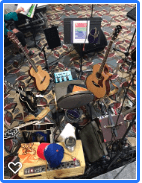
download (1)Many of you know that I own a few guitars. How many, you ask? Well…more than I probably should, but definitely one less than too many. My guitars are part of my very being. Simply put, I believe that I can no more be a good husband, father, pastor, son or anything else God calls me to be without the presence of my guitars. Music ebbs and flows through everything that I am or am called to do or be as a child of God, a disciple of Jesus. I don’t see my guitars as possessions but as extensions of who I am.

I’ve been shopping for a new addition to the family lately. This past Monday, I was able to make a deal on a guitar that I’d been looking at for a few weeks. It’s actually the one that’s on the screen today – and soon, with the help of FedEx, after making a deal on it this past Labor Day Monday, this guitar will become part of our family. And I’m very grateful for that.

Shortly after this exciting purchase and sharing the good news with my wife, I sat down to do a few minutes of sermon study before we had to leave for a brunch that we were invited to attend. As I came to the last verse of our gospel reading, my heart sank. I was still basking in the joy of a new guitar as I heard Jesus say to me “none of you can become my disciple if you do not give up all your possessions.”

Of the four gospels, Luke is the gospel that speaks about wealth the most. Luke points to the way wealth gets in the way of being able to follow Jesus. Being able to be a disciple.

All of the scripture and themes that are before us on this Rally Day – the kick-off to Good Shepherd’s fall ministry and mission – all center us again on discipleship. And what it means to be a disciple of Jesus. This couldn’t be a more perfect theme for this day. Because all too often, the way we live our life each day actually pulls us away from being a disciple of Jesus.

So, let’s take a few minutes and dig a little deeper into this. What does it mean to be a disciple? What is a disciple? Are disciples only the 12 men that Jesus chose to follow him at the beginning of the gospel story? Or are you and I also disciples as the gospel story continues to be told and written in our day and time?

One description for a disciple that I’ve found helpful over the years is this. “A (disciple is a) person who follows Jesus, who is, of course, pursuing us. Being a disciple is always to know that Jesus is on a mission to us – to love us, to save us, and to bless us. And being a disciple is always to know that we follow Jesus on this mission and that Jesus is on a mission through us – to love through us, to save through us, and to bless through us.” [Crazy Talk, Rev. Dr. Rolf Jacobson, pg. 53-54]

Being a disciple of Jesus is not something we initiate, it’s something God initiates through Jesus for us. Being a disciple is not about worrying that we’ll get caught if we don’t obey a prescribed set of rules.

Being a disciple is a way of living that shows others who Jesus is through you. If you are a disciple of Jesus, people around you should know it and experience Jesus in all that you say and do.

How do people in your life right now experience Jesus through you as you participate in worship? Are you just sitting there? Or are you actively engaged and participating?
How will people in your life experience Jesus through you on Tuesday or another time when you are not in a formal church worship service?

At the end of our worship today we will participate in a blessing of our vocations. On this Rally Day, it’s a way that sends us out into the world knowing that everything we say and do in our life, is a reflection of Jesus working through us. The word we use to describe this is our vocation. Whatever vocation you are being called to live out this week, it is Jesus working through you that enables that vocation to exist in the first place.

Jesus is on a mission to you that is being lived out in the world through you, right now.

May the vocations God calls you and me into being a reflection of this truth for all the world to see.

The truth of what a disciple looks like today.

Another description of a disciple that I like is this – “To be a disciple of Jesus is to be a student, learner, or apprentice in a community of mutual growth in love.” [The Agile Church, Dwight Zscheile, pg. 10]

I’ve always seen myself as a student and learner. I’m constantly trying to understand more deeply what it means to be a disciple, what it means to live my life as a disciple. I’m constantly reading, studying scripture, taking classes, and having conversations with brothers and sisters in Christ about faith and life.

All of us who call Good Shepherd our faith home has countless opportunities outside of weekly worship to be students. To be life-long learners of the faith in a community of faith that loves us deeply.

I invite you to get involved over the next few months in at least one of the wide variety of ministry programs and events offered at Good Shepherd. I believe they will challenge you to grow deeper in what it means to be a disciple of Jesus.

And maybe the most pointed description of being a disciple I’ve ever come across is from Dietrich Bonhoeffer in his classic book The Cost of Discipleship. Shortly before Bonhoeffer was executed in a Nazi concentration camp in April 1945, he wrote, “When Christ calls a man, he bids him to come and die.”

When Jesus calls you to be his disciple, he calls you to come and die.

For us, as Lutheran Christians, this call to come and die is exactly what we are talking about when we begin the celebration of the sacrament of Holy Baptism with the words “In baptism our gracious heavenly Father frees us from sin and death by joining us to the death and resurrection of our Lord Jesus Christ.”

You see, baptism is not a five-minute liturgy during a worship service with a bunch of words and promises that have no bearing on the rest of our lives. Baptism joins us to the death and resurrection of our Lord and Savior Jesus. In baptism, we are called to be disciples.

Jesus knows there are many things that will compete for our attention. Many things. Way too many things.

What Jesus asks of us as God’s children who are called to be his disciples, is that we put all of the things that compete for our attention aside and focus only on him and the cross which ultimately gives us life?

Discipleship calls us to come and die. Because it is only in a death like this that we will ever be joined to life with Jesus.

Several times a year, I’m invited to offer an opening prayer or invocation for local events or conventions in town. Often times, a presentation of the colors followed by the pledge of allegiance or singing of the national anthem happens at the same time. At one of these events, the color guard and the pledge of allegiance came before the prayer. This was the first, and only time as far as I can remember, that it has ever happened in this order. I honestly didn’t think much of it. Someone forgot to tell the MC what the agenda for the day was going to be.

After I finished the prayer and left the stage, I was met by the commander of the color guard. He waited for me because he wanted to offer an apology. He said, “I’m very sorry Reverend. Something got messed up in the schedule and I’m very sorry it happened. You have my word that it will not happen again.”

I asked him what was wrong. I thought everything went just fine.

He said, “It didn’t go fine pastor. We are not supposed to present the colors before the prayer. It is always God before country. Always. I’m very sorry.”

Now, I’m far from an expert on this. And I’m not sure there is a steadfast, black and white rule on this. I’ve actually researched it a little and what I’ve found is that it varies a little depending on the type of event or location of the event or who’s at the event. The order is even different between the chambers of the United States Congress – one way in the Senate, a different way in the House.

What struck me in that brief conversation and apology from the commander was not so much the order of things at this event, but the heart of things expressed by a disciple of Jesus. The heart of this decorated veteran now serving proudly and faithfully as a commander of a local color guard reminding me, the pastor, as he said “It’s God before country pastor. It’s always supposed to be God before country.”

“Why yes, sir. Yes. Yes it is,” was the only reply I could offer. And I thanked him for reminding me of that truth.

So, brothers and sisters in Christ, on this Rally Day, in the life of our congregation, I believe that’s all Jesus is trying to say to his disciples – to you and me – again today.
Above your relationship with your father or mother; wife or children; brothers or sisters, your relationship with God is most important and always comes first. Frankly, I do not believe you can have a healthy relationship with anyone else if you don’t have a healthy relationship with God.

Reverend GuitarAnd may our possessions never become things that possess us and take control of our lives if we truly want to be disciples of Jesus. Yes, I am looking forward to that new guitar arriving soon, I’m not going to lie about that. But that guitar, or any other guitar I own, will never get in the way of how I respond to Jesus calling me to serve as one of his disciples.

Finally, as our vocations are blessed today, I hope and pray that we enter this new day and a new week, and a new season of the church’s year, by confidently taking up our cross and following Jesus wherever he may lead. Thanks be to God. Amen.