
Category Archives: Recent Sermons

Holy Land 2024 – A Post-Pilgrimage Reflection

An audio podcast of this blog is available by clicking here.

As I journey home, back to a place of safety, comfort, and some sense of “normal,” I can’t help but think of the friends I have met along this pilgrimage to the Holy Land. Friends that will have a lasting impact on my life and faith. I share this brief reflection with the people who call a Western North Dakota Synod congregation their faith home.

I’ve tried to make this trip three times in the past four years, but have not been able to because of strange things getting in the way – a global pandemic, an extended and unexpected hospital stay, etc. The fourth time was the charm. What is sitting with me now, and I believe will probably sit with me for a lifetime, is how different my expectations of this trip were as I prepared to travel and the reality of the experience as the trip has now concluded.

The psalmist challenges us, “For the sake of my relatives and friends I will say, ‘Peace be within you.’ For the sake of the house of the Lord our God, I will seek your good.” [Psalm 22:8-9]

Truth be told, I expected to see some of the holy sites. I expected to be amazed and grateful, and maybe a little cynical at some of them. A bit too much like Disneyland and less sacred. I expected to eat fantastic food – especially the olives and hummus. I expected to meet nice people – especially Palestinian friends.

What I didn’t expect was the way the Holy Spirit would use this experience to form relationships with fellow children of God that will last forever even though our interactions were very brief. I didn’t expect to have transformational faith experiences by simply touching a stone at the Church of the Holy Sepulcher, kneeling before the manger of the Christ-child, standing on the beaches of the Sea of Galilee where Jesus called his first disciples, or singing a Christmas hymn in the Shepherd’s Fields. Holy moments of conversation with fellow faith leaders like Archbishop Hosam, who serves as the Archbishop of the Anglican Church in Jerusalem, or the Greek Orthodox Patriarch of Jerusalem, Theophilos II, or our gracious host Bishop Ibrahim Azar from the Lutheran Church in Jordan and the Holy Land. These holy sites and spiritual leaders have impacted the faith of God’s children for centuries. I’d be lying if I said that they hadn’t impacted my own faith journey.

I also didn’t expect to learn so much about occupation and genocide and apartheid and colonization on this pilgrimage. I didn’t expect to meet people who are living with these atrocities each and every day of their life. After all, it’s 2024. These things don’t happen anymore, do they?  I didn’t expect to be returning home not only to pray for my Palestinian sisters and brothers in Christ, but also to try and bring voice to so many of them who feel like they no longer have a voice.

I didn’t expect to encounter hope in Christ when everything seems so hopeless.

“My prayer for the church in Palestine, and around the world,” offers the Rev. Dr. Munther Isaac in his book The Other Side of the Wall, “is that God moves our inner spirits to cry and lament the things that are wrong and broken in our communities, nations, and even in our churches…Lamenting our gateway to restoration, just as the cross is our pathway to the resurrection.” During our visit with Pastor Isaac, he passionately reminded us that, “Yes, Jesus died on the cross. But that was not the final chapter. He died so that he and his followers might live again. His death paved the way for a new life and a new beginning. His crucifixion and resurrection serve as an example that life from death is possible…And so today we lament in hope because we believe in the God of resurrection and hope.”

The Holy Land is a land unlike any other. It is a convergence of sacred space for Jews, Muslims, and Christians. It is a land that for centuries has been shared among these three ancient faith traditions. And for the past century or so, it is a land that is becoming less and less welcoming to Christians. Just a few decades ago, nearly one-third of the population of the Holy Land was Christian. Today, less than two percent of the population is Christian. And with each passing day, it is a land that is becoming more and more polarized, political, and divided.

Bishop Ibrahim Azar serves as the shepherd for the Evangelical Lutheran Church in Jordan and the Holy Land (ELCJHL). The ELCJHL is a global companion to the Evangelical Lutheran Church in America, the church I am called to serve. We had the opportunity to meet with Bishop Azar several times during this pilgrimage. At one of our evening dinners, he said something that I believe will shape my understanding of what it means to “strive for justice and peace in all the world” as we promise to do in our baptism and ordination vows, for the rest of my journey in this world.

“I don’t see a future for Christianity if there are no Christians in the Holy Land.”

Bishop Ibrahim Azar, Lutheran Church in Jordan and the Holy Land

The idea of Christianity not being part of the Holy Land story seemed ridiculous just a few years ago. Surely Christianity would remain strong and central to the Holy Land story in much the same way as it has endured for 2,000 years. What I discovered during this pilgrimage is the reality that a Christian presence in the Holy Land’s future landscape may actually not be true. The significant decline in the number of Christians living in the Holy Land in the past few decades is one small reason why I feel this way.

Without fail, every Christian we met along our pilgrimage journey said that something has changed in the Holy Land in the last 10-15 years. Today, persecution of Christians is common and widespread – desecration of cemeteries is celebrated on social and broadcast media, harassment and hate speech are a normal part of daily life, and being arrested for simply claiming to follow Jesus is as common today as it was in the earliest days of the Christian movement following Jesus’ death and resurrection.

I believe that the Holy Land is being afflicted today with things that do not reflect who the Islamic, Jewish, and Christian faith traditions have sought to be for centuries. Over and over again along our pilgrimage journey, we heard, “We are so grateful for you coming to see us in order to see how challenging life is for us. Because you are here, we know we have not been forgotten.” We were the first pilgrimage group to visit since October 7, 2023.

During this pilgrimage, I met beautiful children of God. Too many to remember all of the names. Children of God with beautiful stories. Children of God with beautiful lives. Children of God who are holy and beloved. Children of God who have experienced things I can’t imagine and will never be able to fully understand as a middle-aged white heterosexual man who is a citizen of the United States of America. One small example is that I have never worried about my physical safety or been spit on or arrested simply for proclaiming to be a follower of Jesus or a Palestinian Christian.

I believe there is a future in the Holy Land where Christians can live out their faith free from fear and persecution, but it will require work. It will require people of every faith tradition, or no faith tradition at all, to be able to listen to one another. To listen to each other in ways that humanity has never had to listen before.

During a meeting with our pilgrimage group, the Patriarch of the Greek Orthodox Church, Theophilos II said, “I firmly believe the course of history is guided from above, not from us. But we have our work to do, to do our part.”

I believe more firmly than ever before that the Jewish people of the Holy Land are God’s beloved children and are being called to do their part to bring peace and unity to the Holy Land.

I believe that the Muslim people of the Holy Land are God’s beloved children and are being called to do their part to bring peace and unity to the Holy Land.

I believe that Christians of the Holy Land are God’s beloved children and are being called to do their part to bring peace and unity to the Holy Land. How might you and I as followers of Jesus in this corner of God’s good creation on the prairies of western North Dakota, be beacons of justice and peace to all people, especially to our friends who have called the Holy Land their home for centuries?

Author Rachel Held Evans, author of the books Inspired, Slaying Giant, Walking on Water, and Love the Bible Again wrote these words…“The church is not a group of people who believe all the same things, the church is a group of people caught up in the same story, with Jesus at the center.”

As Anglican Archbishop Hosam reminded us of the truth that Jesus is at the center of our work together as people of faith during our pilgrimage team’s visit to the Anglican church’s offices in Jerusalem, “Whether in times of peace or war,” he told our group, “the Christian church continues to stand and be a presence of the peace and love of Christ. We are a church of resilience and peace.”

May we embrace this truth in all that we say and do. We are a church, grounded in the peace and love of Christ in congregations across the Western North Dakota Synod, throughout the Evangelical Lutheran Church in America, and in every land that we call holy – especially in these days of war and persecution, in the place where the divine became human and lived among us – places that we know as Palestine and Israel, the Holy Land.

As we long for peace and unity in the Holy Land, I invite you to join me in prayer. This prayer is from the hymnal All Creation Sings…

Holy God, out of your great love for the world, your Word became flesh to live among us and to reconcile us to you and to one another. Rekindle among us the gift of your Spirit so that we seek to live in unity with all people, breaking down the walls that divide, ending the hostility among us, and proclaiming peace to those who are near and to those who are far away; through Christ Jesus, in whom we all have access in the one Spirit to you, both now and forever. Amen.


“Called to Serve” October 17, 2021 Sermon

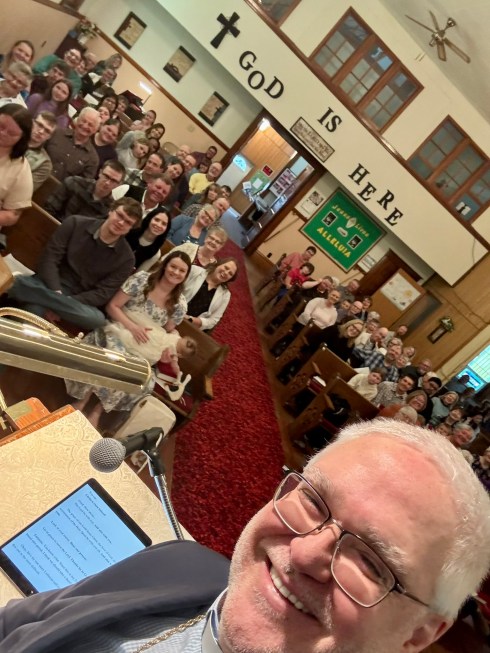
This sermon was offered at Lutheran Church of the Cross in Bismarck, ND on October 17, 2021

Mark 10:34-45 • October 17, 2021

Brothers and sisters in Christ grace and peace to you from God our Father and our Savior Jesus the Christ. Amen.

I give thanks for the invitation to be with you today Lutheran Church of the Cross. For your elected leaders. For Deacon Janie. For Murray Sagsveen who serves so graciously and selflessly as our synod’s attorney.

 And for Pastor Lisa, whom we celebrate today for all that God has done and continues to do through the ministry God calls her into.

I’m able to be in a different congregation of our synod nearly ever Sunday of the year – about 40-45 Sundays. It is a great blessing to be able to worship with so many of our congregations and one of the joys of serving as your bishop.

God is good.

There are a lot of good things happening on the prairies of western North Dakota because God is good and at work through people of faith in congregations like yours.

Congregations who take seriously Jesus calling us into a life of service toward our neighbors, not the other way around.

I also want to take a minute and bring greetings to you, members of Lutheran Church of the Cross, from your brothers and sisters in Christ of the WND Synod – more than 160 congregations, 55,000 or so brothers and sisters serving the western two-thirds of our great state;

I bring you greetings from your brothers and sisters across the ELCA – around 9,000 congregations, about 3 million brothers and sisters across the United States and the Caribbean;

and, I bring you greetings from your siblings in the Lutheran World Federation, of which our denomination of the ELCA is the only representative of from the United States. LWF connects 148 Lutheran denominations, over 77 million children of God, in 99 different countries who, together, are sharing in God’s ministry and mission around the world, we are serving on every continent, except Antarctica.

I offer those greetings from our synod, the ELCA, and LWF every chance I get. They are important for us to hear because they help us center ourselves on just how big the church is that we are connected to – beyond the walls of our local congregations.

And they remind us of who we are, as people of faith who have been called by the Savior of the world into a mission and ministry that is anything but easy – after all, as Jesus tells us in the verses immediately before the ones we heard today…there is a cross and a crucifixion along this path.

Today’s gospel starts with a couple disciples discussing, maybe even arguing about, who is Jesus’ favorite. To which Jesus, in true Jesus fashion, offers a teaching on power and importance as it relates not only to this world, but to God’s kingdom – this world and beyond so to speak. Today’s gospel also speaks to how God’s kingdom looks is nothing like what anyone of us thinks it’s supposed to look like. No matter how many times or in how many ways Jesus tries to show the disciples this fact, the disciples never seem to quite get it.

Remember, Mark’s gospel is the gospel that ends with the disciples running away from the empty tomb in fear and trembling and telling nothing to anyone about it.

If all we knew today of the Jesus story was the disciples account of it from the end of the gospel of Mark, I’m not sure there would be a Christian church today.

Or, more so, followers of Jesus like you and me.

Long before I realized that God had already planted a seed in me, that would one day grow into a vocation serving in the Lutheran church, I was a professional musician. Standing in front of people to present something on my heart usually took place in a smokey jazz club or on auditorium stage, not in a church pulpit.

Another part of my story that I want you to hear…I didn’t grow up Lutheran.

I grew up Roman Catholic.

My family was active in church when I was growing up, but I really struggled to connect.

Yea, I believed, after all, my mom and grandmothers told me I should. But I didn’t really know Jesus as the Messiah or that trying to follow Jesus was going to have a fairly significant impact on the how, what, and why of my life.

You see, I had a lot of questions, and I don’t think my self-absorbed musician ego really cared much about other people or what other people thought – especially not in the way Jesus calls us to think about in today’s gospel.

After a few years of exploring and worshiping within many different Christian denominations, and, to be honest, even exploring other faith traditions, I ended up feeling most connected whenever I was in an Evangelical Lutheran Church in America congregation.

In the ELCA, I felt welcome.

I felt accepted for who I was,

even though I often sounded a lot more like the disciples at the beginning of our gospel today and nothing like a disciple who was willing to actually become the servant Jesus was asking me to become.

And in spite of that, during this time, I was encouraged to ask challenging questions. Questions about faith and God, Jesus and politics, scripture and church hierarchy.

To dig deeply into things about the church that I disagreed with or simply didn’t understand because I thought it was too difficult.

As I look back now, what I think was happening during this season of my life is this…I was encountering people of faith, who called Jesus the Messiah. People of faith who shared in the communal experience of trying to make sense our shared call in life that is rooted in service toward others, not being served by others.

Like James and John, you and I are quick to assume that following Christ Jesus leads to success, power, and glory – especially if we are getting our information on following Jesus from most Christian media today.

You’re not alone in that.

I know that’s what my heart and ego told me as a young musician what being a Christian was all about.

Like James and John, we ask for what we know and think we want, or maybe even think we need – and we know that that always involves success, power, and glory.

The good news of following Jesus is that, this Jesus turns our lust for success, power, and glory on its head: “Whoever wishes to become great among you must be your servant, and whoever wishes to be first among you must be slave of all.”

Being a servant toward others in life-giving and selfless ways is at the center of life together in Christian community.

In this first year serving as your bishop, I’ve spent a lot of time in devotion and prayer walking through the small catechism. Each day I reflect and pray through one part of the catechism.

What does it mean when we pray – as we will today in worship today  – “thy kingdom come”?

Well, according to one of our church’s core teachings, the Small Catechism, it means “In fact, God’s kingdom comes on its own without prayer, but we ask in this prayer that it may also come to us. This comes about whenever our heavenly Father gives us his Holy Spirit, so that through the Holy Spirit’s grace we believe God’s holy word and live godly lives here in time and hereafter in eternity.”

Pastor Shane Claiborne was speaking at a national youth gathering that I attended several years ago. He talked about his faith journey and call into Christian leadership. I don’t remember all the details of his testimony, but I do remember this.

He said that before he started following Jesus, he had everything in his life together. Everything made sense. And everything was under his control.

And then he met Jesus, and everything in his life was turned upside down. Claiborne told the crowd of 30,000 or so Lutheran youth from across the United States that he didn’t think about helping people or loving people unconditionally or serving people, before he met Jesus.

After he met Jesus, he began to think constantly and live his life in ways every day to serve other people – the poor, the hungry, the rich, the lonely. To speak out against things that oppress people, and to love his neighbor unconditionally.

Jesus showed him those things.

And Jesus continues to show him that path along his faith journey.

One of the key parts of Pastor Claiborne’s mission and ministry today is building movements of Christians that look like Jesus again.

Christians that take Jesus seriously about becoming a servant, about being a slave to another;

Christians that take Jesus seriously as children of God receive compassion that asks for nothing in return;

Christians that Jesus seriously and are not afraid to go into our city streets and public schools and government buildings and profess that Jesus is Lord.

Jesus shows us that again today, sisters and brothers, as Jesus invites us into a life of service.

And we don’t do the work of Jesus by beating people over the head with a Bible or arguing over who is the greatest or most important or hating our neighbor because they think different than we do about things like global pandemics and the effectiveness of wearing a mask.

We do this by embracing one another with the unconditional love of God you and I have already received in Christ Jesus.

As we share the grace and truth of Jesus Christ together, I’m not going to say that I always agree with everything our church, the Evangelical Lutheran Church in America, says or does, and I think the ELCA knows that – maybe more so now than before I was called to be a synod Bishop.

But this church, the ELCA, continues to love me and accept me just as I am.

I haven’t found that truth in any other faith community I’ve explored – Christian or some other faith tradition.

A life of faith is expressed through service to one another. The responsibility of each and every one of us, who claim to be a follower of Jesus, is to always remember that individually and in community, we share life together in a covenantal and sacred relationship.

A sacred relationship that is a gift from God.

A covenantal relationship that always calls us to focus on how our life together in community embodies how God wants us to live so that all may be blessed – not just those who sit in a church sanctuary once in a while.

In Pastor Lisa’s 30 years of ordained ministry this is all she has been trying to do.

Whether that was serving on synod council or synod staff, walking with leaders in Luther League or LYO, or listening while helping communities navigate through waters filled with conflict, that was all she was trying to do.

Whether that was serving as a pastor in any number of congregations, congregations with names like St. Paul’s or Grace or Lord of Life or Lutheran Church of the Cross, I believe Pastor Lisa was trying to be a servant in all she said and did.

And even for Pastor Lisa, this self-giving life of service that Jesus has and continues to call her into doesn’t always come naturally.

This is often hard and thankless work.

The same is true for you and for me. If we’re being honest with ourselves.

This doesn’t always come naturally for us – especially those of us living in a country like the United States.

The way of Christian discipleship, and entering fully into a life of faith, calls us into a new set of values.

A new way of seeing the world in which we live.

A new way of life that contrasts with the philosophy of “looking out for number one.”

Again, sisters and brothers of Lutheran Church of the Cross, thank you for the invitation to be with you.

Each one of you is a gift to the work God is calling us into in this little corner of Christ’s church.

I pray that you continue to be abundantly blessed as you seek to serve and not be served in all that you say and do as followers of Jesus.

Amen.