
Category Archives: Recent Sermons

“Playground Rules” 12.16.2012 Sermon

Luke 3:7-18 • December 16, 2012

Click here to hear an audio recording of this sermon.
john-baptist2b

Brothers and sisters in Christ grace and peace to you from God our Father and our Lord and Savior Jesus the Christ. Amen.

Many of you probably didn’t hear what I just said, so I offer it again. Brothers and sisters in Christ, grace and peace to you from God our Father and our Lord and Savior Jesus the Christ. Amen.
As I was making final preparations for this week’s sermon, the news feed on my computer offered headlines of fallen National Guard soldiers being laid to rest, a string of bank robberies taking place across the country, college students being sentenced for drugs, and another horrific shooting. This time in Connecticut.

I’ll be honest, with the news of this past week, the greeting that begins every sermon that I’ve ever preached or ever will preach took on a new and deeper meaning. At the beginning of the week, I was tempted to use something more along the lines of how John the Baptist begins his sermon to the crowds in our gospel reading today. Instead of saying, “Grace and peace to you”, I was thinking of offering, “You brood of vipers! Who warned you to flee from the wrath to come?” I hope you agree that, “Grace and peace to you,” is a better option for today and really every day for that matter.

The Christian church is in the midst of one of my favorite seasons of the year. And no, I’m not talking about the WalMart, Target, Best Buy season that begins in early fall known as the Christmas shopping season. I’m referring to the season of Advent. Advent is a season of the Christian church in the four weeks that lead us to Christmas. It’s a time for peace. A time for reflection. A time to remember that the light of hope always shines. A time of waiting and anticipating the grace that comes to us in a savior named Jesus. Emmanuel. God with us.

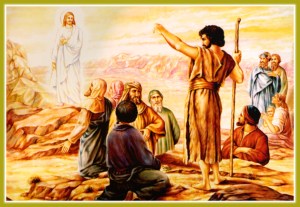
John the Baptist’s teaching to the crowds who have gathered to hear him and be baptized by him in Luke’s gospel remind us of that. John had no idea that eventually there would be a season called Advent or even something called Christmas for that matter. Yet, his teaching helps us understand one of the central realities of Christian faith and life during this season – that Jesus has come and continues to come into the world – broken as it may be and dysfunctional as we are from time to time. I worry that we miss that. We miss the good news that God is already present. Jesus is here.

I once heard a sermon where the preacher offered the shocking revelation that every gift we receive comes with an expectation. If the gift is a book, the expectation is that the receiver will read it. If the gift is a box of candy, the expectation is that the receiver will eat the candy and maybe even share some of it with the giver of the gift. If the gift is a sweater from your grandmother, the expectation is that she will see you wearing the sweater the next time you are together, no matter what size it is or how ugly it may be.

You see, everything that we are and ever will be, comes from God. And everything that we have or ever will have, comes from God. It should not surprise us that God hopes we will use these gifts in ways that honor God as the giver. As Lutherans Christians, we understand this to be lived out most fully as we show love to our neighbors in response to the love we have received from God through our savior Jesus.

If we truly believe this, John the Baptist’s wild and crazy preaching shouldn’t shock us that much, if at all. John is simply reminding us of what we should already know. And how we should already be living.

John’s inviting us to be ready and to believe that God is already at work in the world because the Savior is coming. God is with us. We are called to watch expectantly for signs of God’s presence in the world and more importantly to participate in response to God’s presence in the world. Even if our families are dysfunctional and broken. Even if we’re grieving the loss of a job or the death of a loved one. Even if we’re in failing health. Even if __________, you can insert whatever you wish in that blank. God is at work calling us, turning us, healing us, setting us free, bringing us life.

That’s why of love the season of Advent. Life in Christ is a constant Advent. We are continually waiting to become, to discover, to complete, to fulfill. All of it is part of Advent living.

The world in which we live today is not as just, not as loving, not as whole as we believe it can and should be. And for that matter as God believes it should be. But the coming of Jesus and his presence among us – as one of us – gives us reason to live in the light of hope. Hope that light will shatter the darkness. Hope that we can be liberated from our fears and prejudices. Hope that we are never alone or abandoned.

So, I don’t think that John’s words to the crowds in our gospel reading today should cause us to run away or hide in fear. In fact, his challenge to the crowds, and to you and me, is to be ready and always live expecting our Savior Jesus to come. The crowds ask John, “What then should we do?” After the news headlines this past week, my guess is that many of you are joining me in asking God a question very similar to that one. If you are, then take note of John the Baptist’s response. It actually echoes three simple things that most of us learned on the playground.

John expects those who have a great deal, to give to those who don’t have enough. A coat. Some food. As we wait for Jesus to come, we are invited to remember the simple playground rule of sharing.

John expects the tax collectors who were notorious for collecting far more taxes than were just, to collect only the amount prescribed. As we wait for Jesus to come, we are invited to remember the simple playground rule of being fair to others.
John expects the soldiers who took advantage of their authority and power, to not treat others harshly. As we wait for Jesus to come, we are invited to remember the simple playground rule to not be a bully.

A fellow Lutheran pastor, whom I consider to be a mentor of mine, stated this week, “John the Baptist invites the crowds to participate in God’s coming kingdom wherever they are and in whatever they may be doing.”

Brothers and sisters in Christ, grace and peace to you as you enter the third week of Advent, freely participating in God’s coming kingdom wherever you are and in whatever you may be doing. Come Lord Jesus, come to us we pray. Amen.


“The Pangs of Predictions” 11.18.2012 Sermon

Mark 13:1-8 November 18, 2012

Click here to hear an audio recording of this sermon.

Brothers and sisters in Christ grace and peace to you from God our Father and our Lord and Savior Jesus. Amen.

Wow! What a gospel reading to lead us into this week of Thanksgiving.

The 13th chapter of Mark’s gospel reminded me this week of the story of a young boy who woke up early in the morning of his birthday. He looked out his bedroom window and saw that a large pile of manure had been placed on the driveway of his house overnight. He didn’t know that his father was using the manure that day for fertilizer in the family’s backyard. The birthday boy excitedly jumped out of bed and ran out of the house, grabbed a shovel, and started frantically digging into the manure pile.

His buddy from next door saw him shoveling and came over to see what in the world his friend was doing. “What’s going on?” he asked.

To which the birthday boy responded enthusiastically, “I’m digging out my birthday present. With a manure pile this big, there has got to be a pony in here someplace.”

Which of course brings us to our gospel reading today. This chapter in Mark’s gospel is often referred to as Mark’s “little apocalypse”.

So I’ll honest right away. I’m not a fan of this kind of language or literature, but it is the gospel before us today. It’s sometimes called apocalyptic literature or an area of theological study known as eschatology – the study of the end times. For some reason, human beings for several thousand years have been, and I would argue continue to be, fascinated by this type of literature and thought. Predications of the future consume us. We want to know what the future holds. Not only what will happen later this week, but also what’s going to happen when the world does come to an end as we know it. And we want to know when. I’ve never understood why we want to know when. Is it so we can be ready or something?

Believe it or not, Jesus challenging words in today’s gospel, and the words of similar apocalyptic style writings in the Bible like the book of Daniel or Revelation, are in fact not predictions of the end of the world. For as long as apocalyptic literature has existed, we have skewed its meaning into something that has little to do with what it actually means. These texts often address political unrest during a specific time in history or oppression taking place in society. They’re not about the end of the world or predicting the return of Jesus.

The word apocalypse has little to do with destruction in the Hollywood movie – end of the world – winner take all – kind of destruction that we think will happen when the world ends – in whatever definition for the end of world that you want to use. Apocalypse actually means “to reveal” or “to uncover”. So, what might God be revealing or uncovering.

I think Jesus is inviting us, to stop digging. To stop digging for predictions that we think will tell us the future. To stop digging in the manure pile so to speak trying to find a new pony or a new temple. To stop digging for an answer to a problem that you are trying to fix by yourself instead of reaching out to someone for help. Just, stop digging.

Right before this conversation between Jesus and his disciples in today’s reading, Jesus has addressed issues of power, misplaced priorities, and justice – or rather the lack of justice. It’s been a busy and grueling few days.

Now – travel with me through time from this first century exchange outside the temple walls of Jerusalem to this day, right now, in the temple of Good Shepherd Lutheran Church in Bismarck, North Dakota. Think about all the things that you brought with you to worship in this temple that have caused you to be exhausted from digging. Not much has changed really, has it? Human beings like you and me still misplace our hope in grandiose temples that we build, or individuals that we place on thrones of power, or our never ending quests for more and more wealth, or celebrating the strength of one that defeats another. Life is still chaotic.

In spite of great scientific and social and technological advances over the past 20 centuries since Jesus walked the earth, millions of people still suffer from oppression and injustice, still live in poverty, and still suffer from great violence. If you’ve seen any news in the last week you know this to be true. Wars and rumors of war; famine and gruesome death; earthquakes and destructive storms continue.

I know I’ve been quoting Professor David Lose from Luther Seminary a lot recently, but he has been writing some really incredible things in the last few months. Here’s what Dr. Lose wrote this week in a reflection about our gospel reading this week. “We want to know when, we profess, so that we can be prepared, so that we can be ready. But perhaps that’s the point: we are invited to be ready all the time. We are not called simply to live our lives with no thought of God or neighbor but keenly looking for the sign of God’s imminent coming so that we can clean up our act. Rather, we are called to live always anticipating the activity of God.

We are called to live now, allowing the promises of God about the future to infuse our every present moment. Because when you live looking for the activity of God here and now, you begin to see it. God shows up in all kinds of places, working with us, for us, through us, and in us. You just have to look.”

Brothers and sisters in Christ, take time to look this week. God is active today making all things new, giving us hope for tomorrow. Our gospel reading today speaks a word of truth and hope that you and I need to hear. And I’m not talking about terrifying predictions of the end of the world. I’m talking about Jesus words in verse 7. “Do not be alarmed.” Jesus says.

Jesus says, “Do not be alarmed when you hear of wars and rumors of wars.” What wars are raging in your life that only the peace of Jesus Christ can turn around?

Jesus says, “Do not be alarmed when nation rises against nation, and kingdom against kingdom.” What kingdoms do you need to let fall right now in order for your world to be turned around by God and made new through his love for you?

Jesus says, “Do not be alarmed when there are earthquakes in various places and famines.” What earthquakes do you feel shaking your very being today? What hunger are you trying to fill by non-stop, frantic digging? Turn around. Come to the table. Be fed.

Do not be alarmed. Jesus Christ, your risen savior and Lord, is with you today and will be with you in every tomorrow. Amen.