
Luke 3:1-6 • December 6, 2015
Click here to view a video of this sermon.
Brothers and sisters in Christ grace and peace to you from God our Father and our Savior Jesus the Christ. Amen.
There are four words that mark our journey together this year in Advent as part of the worship series “The Geography of Waiting.” This week the word is courage. I think that’s a good word for the season of Advent – courage. After all – it takes courage to keep up with everything happening during this month of preparation. It takes courage for many of us to simply make it through this month because of past pain or loneliness or longing for Christmas to be the way it used to be.
 Advent is a season of the church that takes us on a journey. A journey that begins with preparing our hearts and minds for the coming of the Christ-child. And this time, this year, finally…Jesus will have a proper place to be born. Peaceful. Gentle. Bethlehem. It takes courage to make this journey to Bethlehem each year. Believe it or not, the Bethlehem the writers of the four gospels talk about doesn’t really look very much like our Christmas TV specials and greeting cards.
There are two times early in the gospel of Saint Luke that we hear the names of some of the most powerful people of the 1st Century. One theologian sees these names as being important to Luke’s proclamation of the good news of Jesus like this. They write, “Christ stands within human history, fulfilling in unexpected ways the religious expectations of God’s people. Also today, the body of Christ lives in the real world and shows to “all flesh” God’s salvation. We are to reorder the world and build a royal triumphal highway for the coming of the Lord, in the present and the future.”
As we hear the names of these powerful 1st century figures, we are invited to hear them with 21st century ears. Because the name that gives us courage as we live out our faith today is not Pontius Pilate or Emperor Tiberius or even Herod. It’s easy to actually miss the one that shows us courage in the chaos of this list or the chaos of our lives today.
John, son of Zechariah gives us courage. This ordinary, simple man of courage, is not satisfied with the way things are. John’s proclamation and witness in the wilderness are preparing us for the coming of one who will turn the world upside down. And as we make these preparations, John pleads with the world of the 1st century, and with us in the 21st century as well. He pleads with us to examine our own lives and the world around us. In this examination – we are called to repentance. It takes courage to repent. A kind of courage that doesn’t come from being politically powerful or popular or rich or arrogant or self-centered.
Hopefully by now in your faith journey, you are aware that there are four gospels in the Bible. And without trying to be overly simplistic, a gospel, more or less, is the story of the good news of Jesus, the Son of God and Savior of the World. So…isn’t it interesting that the birth story of Jesus is not part of all four gospels. But the story of John the Baptist and his proclamation of preparing the way and repentance is part of all four gospels. I don’t think this is accidental on the part of the gospel writers. I think it shines light on the fact that God can do extraordinary things through ordinary people like John, son of Zechariah. And God is still doing extraordinary things in the world today though people like you and me. John’s proclamation and witness ring just as true today as they did 2,000 years ago. John’s proclamation that those who claim to follow Jesus are supposed to tell others about this Jesus. And, John’s witness that repentance is kind of a big deal for our life together in faith.
Rolf Jacobson, one of Luther Seminary’s fine Old Testament Professors, wrote a great little book a few years ago called Crazy Talk: A Not-So-Stuffy Dictionary of Theological Terms. In this book, Jacobson defines repentance as, “The change in a person’s behavior that follows recognition of having sinned and immediately precedes further sinning.”
“In proclaiming a baptism of repentance for the forgiveness of sins,” Pastor Denise Anderson states, “John makes no distinctions between any of us. All flesh shall see the salvation of the living God. All are in the same boat. All are called to this baptism, to this repentance. We are no better than our enemies, no worse than our detractors. And that’s good news.” (T. Denise Anderson, The Christian Century, November 25, 2015, p. 21)
I heard a wonderful commentary on National Public Radio a day or two ago. The commentary was about the power of prayer and how important this is to so many of us. This is even true in times of tragedy and trauma for those who claim to not believe in God. The commentator was challenging us as listeners that simply offering to pray for someone or something with no intent of actually doing something or being open to being changed by the prayer kind of defeats the point of prayer all together. He concluded his commentary by saying that, “maybe the merit of prayer is what you do after you say amen.”
 I’d like to believe that the merit of repentance, for all of us who have come to follow Jesus after John the Baptist, is what happens after we repent. Especially in light of the unmerited and unconditional grace and forgiveness that we receive from our Savior Jesus.
You see, repentance is not simply a warm fuzzy feeling that comes over you after you finally say you’re sorry to someone you’ve wronged. Confession and repentance, for stewards of God and disciples of Jesus, is not just the removal of consequences like guilt or punishment. Confession and repentance is necessary for the complete, complete, transformation of the sinner. In the wake of our repentance, we are different people than we were before. Martin Luther said that “the entire life of the believer should be one of repentance.” Did you hear that? The entire life of the believer should be one of repentance!
Now the last time I looked, my schedule is not packed with people coming to repent or seeking forgiveness for their sin. As I’ve prayed about and reflected on the story of John the Baptist this week – a story that we hear every year in the second week of Advent – I don’t know…maybe my schedule should be a little busier with brothers and sisters seeking repentance. Maybe.
I will close very simply today, with a poem. This is from one of my favorite poets, Anne Weems, in her collection Kneeling in Bethlehem. It’s called “The Coming of God”
“Our God is the One who comes to us in a burning bush,
in an angel’s song, in a newborn child.
Our God is the One who cannot be found locked in the church, not even in the sanctuary.
Our God will be where God will be with no constraints, no predictability.
Our God lives where our God lives, and destruction has no power and even death cannot stop the living.
Our God will be born where God will be born, but there is no place to look for the One who comes to us.
When God is ready God will come even to a godforsaken place like a stable in Bethlehem.
Watch…for you know not when God comes.
Watch, that you might be found whenever, wherever God comes.”
 Have courage brothers and sisters in Christ. We’re on our way to Bethlehem. A journey of preparing the way for the coming of the Lord and of repentance. Bethlehem is a whole lot closer that you and I realize. And the good news of Jesus Christ is that, once we’ve been to Bethlehem, we will never be the same again. Amen.

 I’ve always found it interesting when someone approaches me and says something like, “You know what pastor, that worship service was horrible. I didn’t get anything from it.” Or someone will say to me, “That was the worst bible study I’ve ever been too. I didn’t get anything out of that. What a complete waste of my time.”
 Brothers and sisters, you and I are recipients of God’s grace. Everything that we have ever been, are today, or ever will be is a gift from God. And everything that we have ever had, or have today, or ever will have is God’s…first. That is why we gather together in community to worship. That is why we are on a lifelong journey of learning and discovery as we listen together for God to speak to us through holy scripture.
 The statistics on giving in the
  “Solomon does not condemn riches, nor does he forbid that we acquire riches or food or drink. But he calls these things gifts of God in order to teach us to put down our anxieties; then we shall wait for all of these things from God by faith and when God wills shall surrender them with patience…Therefore riches are not to be rejected. Nor are they granted to us by God for the purpose of rejecting them or abstaining from them, but rather so that we use them and distribute them to the poor…Solomon intends to forbid vain anxieties, so that we may happily enjoy the things that are present and not care at all about the things that are in the future, lest we permit the present moment, our moment, to slip away.” [Luther’s Works 15:93]
 blessed, we are also a blessing to those who we are sitting beside right now and millions of others around the world, including our brothers and sisters in Paris this weekend through
 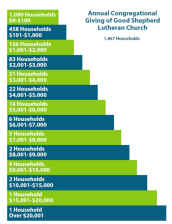 If you haven’t yet had a chance to look at the two giving charts that are part of the bible study packet you’ve been receiving as you leave worship, I encourage you to do so this week. Look at where your household rests in the Annual Congregational Giving of Good Shepherd. I invite you to prayerfully consider how God may be calling you in your future annual giving to support God’s ministry and mission through this congregation.

 Bishop Craig Schweitzer