
Brothers and sisters in Christ, grace and peace to you from God our Father and our risen Lord and Savior Jesus. Amen.
Disciple Lutheran Parish and the congregations of Faith, Bethlehem, and Knife River, thank you for the invitation to be with you this weekend. I’m so very grateful for your elected leadership, your Synod Authorized Ministers, and everyone who calls a congregation of this parish their faith home.
You are a gift for which I am very grateful.
God’s work through the Western North Dakota synod is better and stronger because of you.
Thank you for the many ways you support the mission and ministry of this church – your prayer, your hands, feet, voices; and, your financial gifts. Thank you.
Let’s see if you’re still with me this morning Lutherans…
I say…
Alleluia! Christ is risen!
You say…
Christ is risen indeed!
Good. How about…
The Lord be with you. And also with you.
The grace of our Lord Jesus Christ, the love of God, and the communion of the Holy Spirit be with you all. And also with you.
Lord, in your mercy. Hear our prayer.
Go in peace to serve the Lord. Thanks be to God.
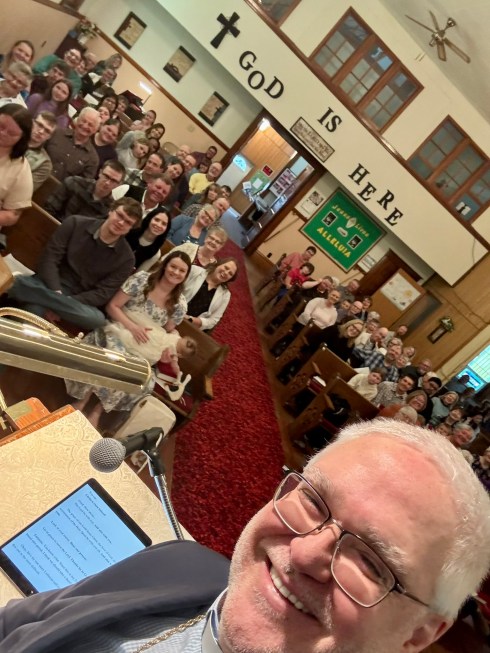
Fantastic. You know what. Since this is my first visit to this brand new parish, I think we should take a family photo.
Okay, let’s try one more Lutheran call and response. I think this one is the most difficult.
Are you ready for it?
The peace of our risen Lord and Savior Jesus Christ be with you all. And also with you.
Thank you and you are awesome. And yes, I did in fact say that the last one was the most difficult one. More on that in a minute.
One of the great blessings of this call serving as your bishop is that I get to be in a different congregation of our church nearly every Sunday of the year. And one of the things I always like to do when I’m in congregations of our synod is to bring greetings of peace to you from your brothers and sisters in Christ across the western North Dakota Synod – nearly 160 congregations serving the western two-thirds of our great state.
I bring greetings of peace to you from your brothers and sisters in Christ across the Evangelical Lutheran Church in America – about 8,500 congregations serving across the United States and the Caribbean.
And I bring greetings of peace to you from your brothers and sisters in Christ who are part of the Lutheran World Federation or LWF. LWF connects 149 Lutheran denominations together – of which the ELCA is the only representative of from the United States. It’s about 77 million children of God serving in 99 different countries around the world in Christ’s name. LWF is a global mission and ministry that began shortly after World War II that was formed to help rebuild churches and communities impacted by the evil of war.
Through relationships centered in Christ’s peace like our synod, our denomination, and global ministries like LWF, Lutheran Christians serve on every continent on Earth.
In our gospel reading today from Saint John, the disciples are locked in a room in fear.
Jesus comes to them and says, “Peace be with you.”
And he doesn’t just say this once, but three times.
“Peace be with you.”
Jesus also says, “As the Father has sent me, so I send you.”
And if that wasn’t enough, Jesus also challenges his followers – and you and me today – with a seemingly impossible task, “If you forgive the sins of any, they are forgiven them; if you retain the sins of any, they are retained.”
Holy cow.
If living in peace, being sent by God into the world to do God’s work, and forgiving others who have sinned against me are what it means to follow the risen savior Jesus, I can kind of understand why those first disciples were locked in a room somewhere and were afraid. I’d be afraid too.
And still today, you and I think Jesus has some nerve, coming to us in peace.
What is he thinking!?!
Doesn’t he know that one of the fastest growing and most profitable industries in the modern world is security. National security. Personal security. Home security. Financial security. Internet security.
Peace? Jesus, come on.
You and I invest aggressively and abundantly in security.
In so many ways, it’s an effort to contain the chaos of the world around us and lock ourselves in rooms that we think give us complete control and safety.
But…Peace?
I mean, isn’t it just easier for us to move through life – and even through our life of faith – locked behind doors that we build with our own individual version of faith, walls of security that keep people who are different from us out of our life?
Walls of security that protect us from embracing the peace that is a relationship with the savior of the world Jesus Christ.
At least that will give us some sense of peace. Right?
We just need to lock ourselves in a room.
Build another wall of security.
Then we’ll find peace.
In the gospel story before us, not just today, but every time we enter into the gospel story of the savior of the world, the risen Jesus, we see Jesus teaching us a better way forward.
A better way, for those of us who claim to be his followers. that begins and ends with peace.
Now, let’s be real here. I’m not going to take down the security systems on my computer and trust that the wickedness of computer hackers will leave me alone because they know I follow Jesus.
And I’m not going to get rid of the home security system that I have because I trust that people with evil intentions will leave my house alone because they see the cross in my front yard, so they have to know I’m a Jesus follower.
But, Jesus, greeting me with peace does give me pause…to reflect on how I am greeting others and how I’m in relationship with others, even if I don’t like them or agree with them.
Jesus is challenging you and me to live out all of our relationships – at work, at play, at the grocery store – with the peace of the risen Christ at our center.
Sisters and brothers in Christ, let’s be honest.
That’s easier said than done.
Here’s where I’m hoping you and I can focus our attention today, and really, in every part of our life together in Christ.
Because, I think it’s often the one facet of following Jesus that we frankly don’t take all that seriously.
And let’s be honest with each other this morning, the broken world in which we live, desperately needs us to take it more seriously.
Remember, Jesus offers the greeting, “Peace be with you,” three times in today’s gospel reading. On one level, this was a common greeting in Jesus’ day. Similar to us saying “hello” or “what’s up” to someone today.
But I think Jesus offers something different, especially after the resurrection, with this greeting of peace.
I think his greeting, post-resurrection, is much more significant that simply saying, “Hello.” to each other.
Jesus talks about peace many other times in the gospels, before the resurrection. In John’s gospel, chapter 14, “Peace I leave with you; my peace I give to you. I do not give to you as the world gives. Do not let your hearts be troubled, and do not let them be afraid.”
In chapter 16, still in John’s gospel, Jesus says, “I have said this to you, so that in me you may have peace. In the world you face persecution. But take courage; I have conquered the world!”
I’ve been privileged over the past four years to serve as your Bishop and have been invited into conversations, into planning and teaching in various settings of our life together as church.
From time to time, what I’ve experienced has little to do with peace in a “hey, how are you doing” kind of way.
And, more often than I will ever admit in public, these conversations have nothing to do with peace in the way our savior hopes we will live.
Now, that doesn’t mean that I’m always looking for kumbaya moments as the only way we are called to live.
This life we live as followers of Jesus is tough at times.
Conflict and disagreements happen.
Evil is still present in the world.
Remember, Satan believes in God too.
I am fully aware that you will probably not agree with everything I say or do as I try to faithfully serve as your Bishop. That’s okay. We are still all part of the one body of Christ.
And, as I openly express from time to time, I don’t always agree with everything that the ELCA says or does either. That’s okay. I’m so very grateful that there is room at the table for all of us in this church, regardless of whether we always agree with one another about everything. We are all part of the one body of Christ.
Here’s the thing though.
I do believe with everything that I am or ever will be as a child of God who has been called to serve as your bishop at this time in history. I do believe, that the peace of Christ – and our ability to share Christ’s peace with others – extends far beyond any conflict or disagreement you and I may ever have.
That’s proven to be true for more than 2,000 years.
I believe it will continue to be true until the very end of time, when the savior returns.
Sharing Christ’s peace with one another is not simply offering a friendly hello.
Sharing Christ’s peace with one another is an act of reconciliation. It is an opportunity for God’s children to be reconciled with one another. It is something that allows us to set aside human differences and to recognize and demonstrate our very identity as followers of Jesus the Christ the risen Savior of the world.
That is why Jesus’ words of peace still mean something today.
And, to be blunt, I think they are even more powerful for us to hear and receive when heard alongside Jesus’ statement to the disciples in verse 23. A statement Jesus first made to his disciples in the ancient first century world and is still making to his disciples in 2025.
Jesus says to us, “If you forgive the sins of any, they are forgiven them; if you retain the sins of any, they are retained.”
Brothers and sisters in Christ, thank you again for the invitation to be with you this morning – a morning of celebration and anticipation of future ministry together, and a morning of looking in new ways at what it means to live in the peace of Christ for people who claim to be followers of this Jesus.
As we live as God’s children on this side of the resurrection, the presence of the risen Jesus in our lives extends peace that is far more than a simple morning greeting.
The presence of the risen Jesus forgives all sin.
The presence of the risen Jesus brings restoration and healing to all relationships.
The presence of the risen Jesus is given to you and me in love, as a gift, that you and I receive each and every time we hear the words, “Peace be with you.”
Amen.
I think this is scheduled for a bit later in our liturgy today but now seems like as good a time as any. I invite you to stand as you are comfortable. Let’s take a moment and share a sign of Christ’s peace with one another.
The peace of our risen Lord and Savior Jesus Christ be with you all. And also with you.

 Bishop Craig Schweitzer