
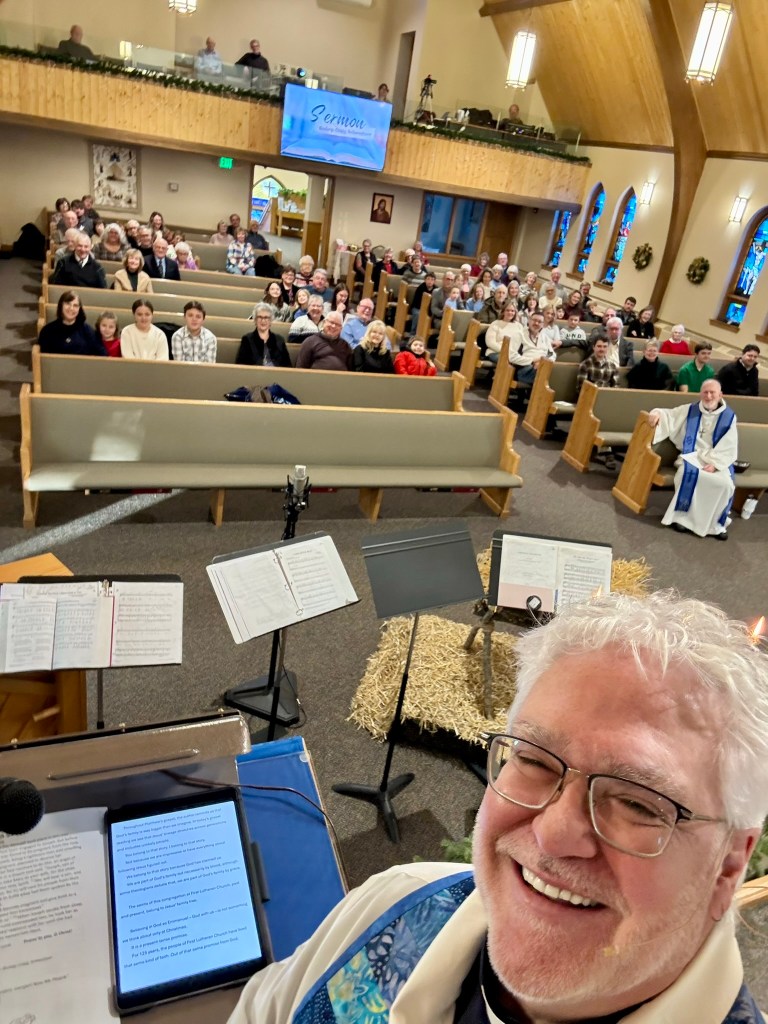
This sermon was offered to First Lutheran Church in Bottineau, ND, on December 21, 2025, on the Fourth Sunday in Advent.
View the livestream video of the worship service here.
Grace to you and peace from God our Father and our savior Jesus, the Incarnate One, Emmanuel, God with us. Amen.
It is so good to be with you this weekend First Lutheran Church. I again apologize for not being able to be with you in person during your recent anniversary celebration. I was with you in Spirit. And I was able to join you on the livestream too, which was awesome.
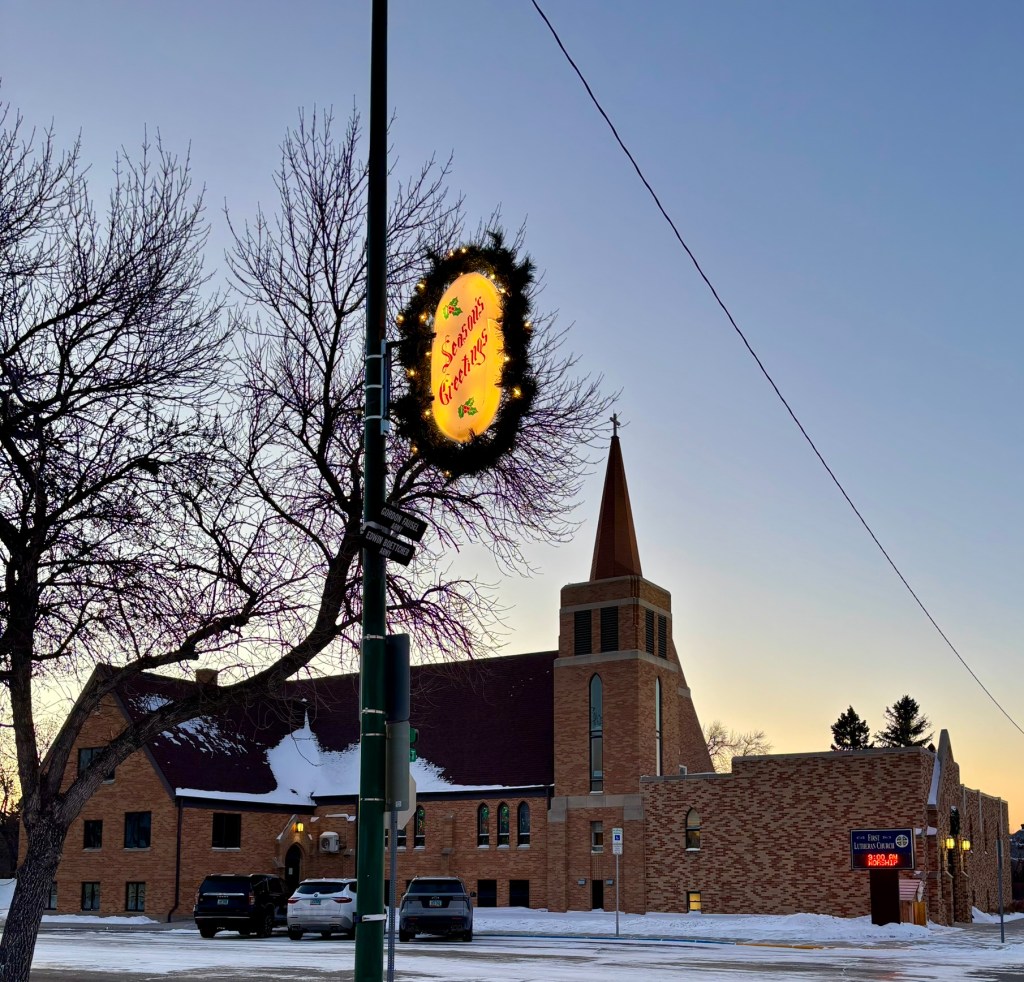
Ministry anniversaries are holy times. They invite us to look back. But, as we have witnessed throughout this season of Advent again this year, we are also mindful that anniversaries insist that we also look forward. Advent calls us to do the same.
So, on this Fourth Sunday of Advent, with Christmas just days away, today’s gospel does not let us linger too long in memory. Instead, it gives us a story about trust, about courage, and about God showing up.
Matthew’s telling the story of Jesus’ birth has always been interesting to me. I’ve always found it interesting in the way that it feels so surprisingly quiet.
There are no shepherds keeping watch by night.
No angels filling the sky with song.
Instead, Matthew gives us Joseph.
Joseph, who never speaks a word in this story.
Joseph, whose faith shows up not in what he says, but in what he does.
Joseph is engaged to Mary when everything changes. She is pregnant, and Joseph knows the child is not his.
Matthew tells us that Joseph is a righteous man. But in this case, being righteous doesn’t mean that he is a rigid rule-follower.
It means compassion. It means mercy.
It means he plans to dismiss Mary quietly, to spare her public shame.
But then God shows up and interrupts, as God does, God interrupts Joseph’s carefully planned solution. In a dream, an angel tells him not to be afraid. Do not be afraid to take Mary as your wife. Do not be afraid of what people will say. Do not be afraid of a future you did not choose.
Joseph wakes up—and he does what the angel of the Lord commanded him. He takes Mary as his wife. He names the child Jesus. He steps into a future that is not very clear, trusting the promise that God is with him. That God is at work.
A few interesting points to remember about this story. The virgin birth is actually not the hardest thing Advent asks us to believe.
The prophet Isaiah imagines a world without war.
John the Baptist proclaims that God’s kingdom has come near.
Mary sings of the hungry being fed and the powerful being brought down.
None of those things is easy to see. Or believe.
All of them depend on God interrupting what we have come to accept as “normal.” God showing up.
After all, that is what Emmanuel does. Emmanuel – God with us – enters the ordinary and interrupts it with grace. Emmanuel – God with us – shows up not only in moments of joy and celebration, God also shows up in moments of decision, when faith means trusting God enough to move forward without all the answers.
Joseph never gets certainty. He gets a promise.
And for Joseph, and for you and me too, that is enough.
During one of the recent anniversary celebrations here at First, Pr. Glenn said that someone had asked him what kind of communion you were doing on the weekend of the anniversary. Pr. Glenn’s response: “Holy.” And then he shared a prophetic word with us about why communion is holy.
“When we gather for communion,” he said, “it is a holy time. It is a sacred moment when we are in communion with God. We come into unity with God. We make a mistake if we think this is just a moment between Jesus and me, because this is much larger than that. When we come to receive communion, we don’t come alone. People from all time and all space are united with us.”
Throughout Matthew’s gospel, the author reminds us that God’s family is way bigger than we imagine. In today’s gospel reading, we see that Jesus’ lineage stretches across generations and includes unlikely people.
You belong to that story. I belong to that story.
Not because we are impressive or have everything about following Jesus figured out.
We belong to that story because God has claimed us.
We are part of God’s family not necessarily by blood, although some theologians debate that, we are part of God’s family by grace.
The saints of this congregation at First Lutheran Church, past and present, belong to Jesus’ family tree.
Believing in God as Emmanuel – God with us – is not something we think about only at Christmas.
It is a present-tense promise.
For 125 years, the people of First Lutheran Church have lived that same kind of faith. Out of that same promise from God.
Faith that reminds us that because of what God is doing, we are connected to one another and all of God’s creation in ways that we will never fully understand – at least not in this life, and in ways that are far bigger than anything we can possibly imagine on our own.
God is with you in this season of your life together today. God is with you in your leadership in this congregation, in your questions, in your hopes for what comes next.
I mean, think about it.
God is connecting us together with nearly 160 congregations across the western two-thirds of North Dakota, more than 50,000 sisters and brothers. God is connecting us together with nearly 9,000 congregations of the Evangelical Lutheran Church in America, about 3 million sisters and brothers in Christ across the United States and the Caribbean. And God is connecting us together with tens of millions of other Lutheran Christians, 150 different Lutheran denominations, serving together on every continent on the globe through partner ministries like the Lutheran World Federation, ELCA World Hunger, Lutheran World Relief, Lutheran Disaster Response, Global Refugee, and many others.
Emmanuel – God with us. Wow!
Not always with certainty. Not always with clarity. But with trust.
Trust that God is present even when the way forward is not obvious.
Trust that love is always worth choosing.
Trust that God will never abandon this place or any one of us, ever.
Advent does not ask us to have everything figured out.
It asks us to recognize Emmanuel, even when God comes quietly.
To trust that God is near, even when the future is still unfolding.
To step forward, like Joseph did, believing that God is there.
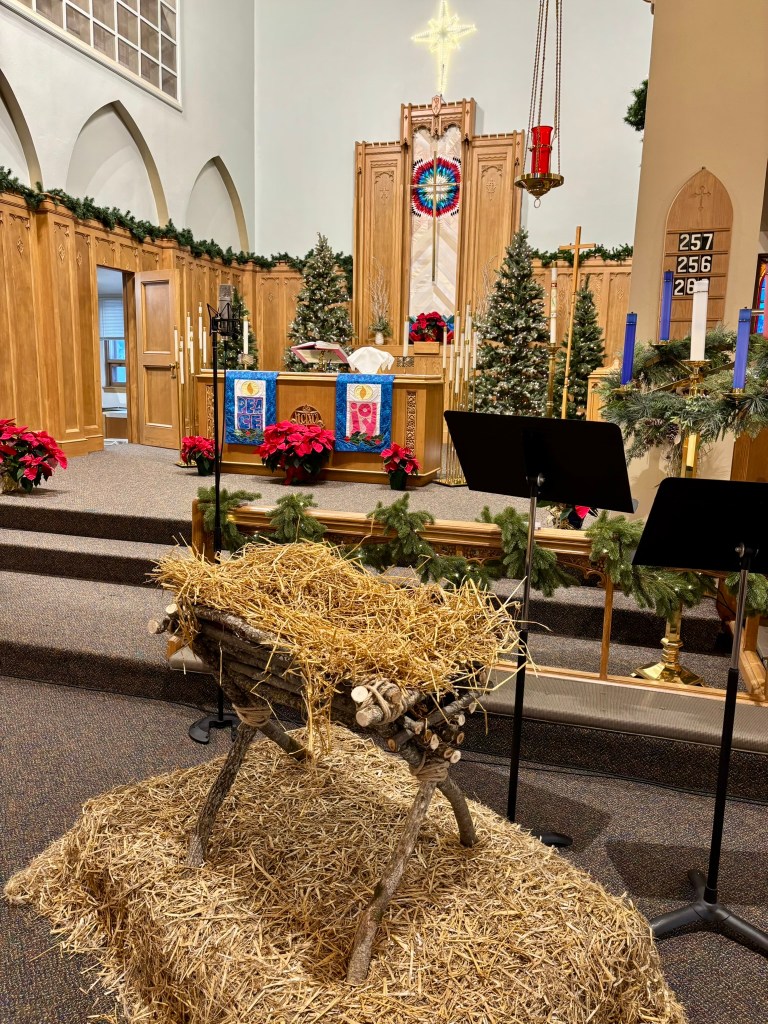
In just a few days, we will celebrate the birth of a child. Let’s not rush too fast past the manger and forget that Advent is inviting us to hear his name again—Emmanuel—God with us.
As we hear that name, may we boldly step forward in faith, knowing that we have nothing to fear.
Since I won’t be able to offer this in person in a few days, I want to wish you a blessed, holy, Merry Christmas.
Sisters and brothers in Christ, God is with you. And for that eternal promise, we simply say thanks be to God! Amen.

 Bishop Craig Schweitzer