
 Mark 1:29-39 • February 5, 2012
Click here to hear the audio recording of this sermon.
Brothers and sisters in Christ grace and peace to you from God our Father and our Lord and Savior Jesus. Amen.
I think many of you might be asking a question today after just hearing this gospel reading. It may sound something like this, “If Mark’s gospel is in such a hurry with his abundant use of the word immediately and quickly changing scenes, why are we spending five weeks getting through one chapter?” If you’re asking that question, good. It’s a good question. And my pastoral response to your question is this – “Because.”
In other gospels Jesus proclaims his ministry – his mission – his purpose so to speak – in lengthy, beautiful sermons like the Sermon on the Mount in the gospel of Matthew. In Mark, it’s a little different. Instead of several dozen verses and a few chapters of scripture, the Jesus in Mark’s gospel gives us one verse, Chapter 1, verse 15, with Jesus saying “The time is fulfilled, and the kingdom of God has come near; repent, and believe in the good news.” Or as the paraphrase of scripture called The Message puts it, “Time’s up! God’s kingdom is here. Change your life and believe the Message.”
Mark chapter 1, verse 15, may just be the shortest sermon ever offered in the history of humanity. It’s pretty revealing that centuries after Jesus first spoke these words; we’re stilling trying to figure out what they mean and how we are being invited each day to live as brothers and sisters in Christ if we really do in fact believe what this new teaching from Jesus claims.
When we hear Jesus say, “The time is fulfilled, and the kingdom of God has come near; repent, and believe in the good news.” what do you hear? For many of us, it’s not so much a matter of whether we believe these words; we’re just not sure what to do with them. I mean – your plate and my plate are already way too full.
A couple of weeks ago I was getting ready to go home after our Saturday evening worship service. My phone rang. It was one of my daughters informing me that they were standing in line at HuHot and it wouldn’t be too long before we would get a table, so I should come and have dinner with them. It was the first HuHot Mongolian Grill experience for our family, so I gladly went.
Dining at a Mongolian grill is an interesting experience. Not only because of the way the food is prepared, but also the way in which we, the customers, participate in that preparation. You grab a bowl, which by the way are simple and very adequate serving size bowls. Not too small. Not too large. You place the ingredients that you would like to eat in the bowl and take your bowl to the grill to be cooked.
However, it quickly became clear to me that the size of the bowl was not adequate for the amount of food that I thought I needed to choose. I desperately tried to figure out how I was going to get everything I wanted to eat in this now itty bitty, tiny little bowl. And then I remembered what our waitress said, “You can go back, if you would like more.” I sighed in relief.
So in this first trip, I was very selective with the amount of ingredients I chose. I didn’t want to exceed the capacity of the bowl. And I have to say, I think I was successful in that quest.
As we made our way to the grill, what surprised me was that I was one of only a few who had selected just enough ingredients to actually fit into the bowl. Most everyone else had filled their bowls way beyond capacity. They were struggling to keep all of the food in or on top of their bowl.
As I watched many struggle, I thought about the many times in my life that these bowls reflected. The many times in life when there were way more ingredients placed in front of me than I could actually keep in my bowl. Some would fall to the floor. Some became smothered by the constant weight and pressure of other things on top of them?
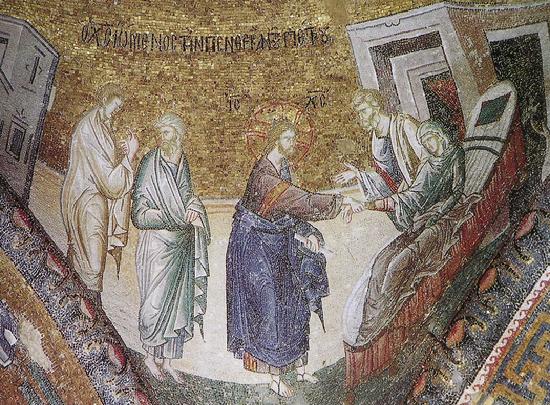
“Everyone is searching for you,” is what the disciples say to Jesus in our gospel reading today. Jesus had a busy day – healing a man possessed by unclean spirits in the synagogue, releasing a fever from Simon’s mother-in-law, and countless other healings throughout the day.
Everyone was clamoring to see this Jesus and experience for themselves how the kingdom of God was coming near. From the very start of the gospel of Mark, Mark reveals just how many ways Jesus proclaims and witnesses to the kingdom of God. And in today’s gospel Mark also reveals the source of Jesus authority and power as he tells us that Jesus rose early in the day to be alone with God in prayer.
All of us have times in life when we feel more like a piece of vegetable at the bottom of our HuHot bowl, crushed by the weight of an 80 hour work week that we try to maintain? Weightless as we fall to the floor after being pushed over the edge because of emotional stress that simply can’t fit on top of our already over stacked bowls. Clinging to relationships and habits that we should have let go of years ago? They cause us to constantly be sick with a fever and keep us from experiencing the healing touch of Jesus.
The question I have for you today is this – How are you getting away to be alone with God in prayer? Times of prayer that reveal God’s strength and faithfulness and healing touch given to you through a savior named Jesus.
Saint Jerome said that we all have fevers in a sermon that he preached around 400 A.D. in Bethlehem. “O that he (Jesus) would come to our house and enter and heal the fever of our sins by his command. For each and every one of us suffers from fever. When I grow angry, I am feverish. So many vices, so many fevers.”
And nearly 16 centuries later, Bishop NT Wright said, “With Jesus, God’s rescue operation has been put into effect once and for all. A great door has swung open in the cosmos which can never again be shut. It’s the door to the prison where we’ve been kept chained up. We are offered freedom: freedom to experience God’s rescue for ourselves, to go through the open door and explore the new world to which we now have access. In particular, we are all invited – summoned actually – to discover, through following Jesus, that this new world is indeed a place of justice, spirituality, relationship, and beauty, and that we are not only to enjoy it as such but to work at bringing it to birth on earth as in heaven.” Bishop Wright continues, “In listening to Jesus, we discover whose voice it is that has echoed around the hearts and minds of the human race all along.” (This quote is from the book Simple Christian: Why Christianity Makes Sense)
So we get to spend five weeks in the season of Epiphany in the first chapter of the gospel of Mark. Thanks be to God.
And I hope and pray that our time with this one chapter in this one gospel, causes you and I to experience new life as we feel Jesus’ healing touch. That it empowers us to remember that the number of ingredients and the size of our bowls is not a burden, but a renewing freedom challenging us to serve one another. And that it challenges us to purposely spend time with God in prayer, which restores us and makes us whole through the strength and power and healing touch that we are given in Christ Jesus our lord and savior. Amen.

 Bishop Craig Schweitzer